Advanced Engineering Consultancy & Testing Laboratory
Centre for Advanced Testing, Inspection and Engineering Solutions
Advanced Engineering Consultancy & Testing Laboratory
Centre for Advanced Testing, Inspection and Engineering Solutions

Coating Adhesion and Bond Strength Testing – Laboratory and On-Site
AECTL provides pull-off adhesion testing of protective coatings, paint systems, linings and other bonded surface systems to assess their tensile bond performance on steel, concrete and other rigid substrates. Testing can be undertaken at our Sydney laboratory or on site using an automatic, electronically controlled hydraulic adhesion tester.
The test applies an increasing tensile load perpendicular to the surface until separation, fracture or a nominated proof condition is reached. The measured pull-off stress is considered together with the location and nature of the fracture. This distinction is important because a numerical result alone does not identify whether the weakest plane was the coating-to-substrate interface, an intercoat boundary, the coating itself, the substrate or the adhesive used to attach the test dolly.
Pull-off testing is therefore useful for coating quality control, specification compliance, coating qualification, condition assessment and investigation of premature peeling, delamination or bond failure.
Testing can be undertaken in accordance with the applicable Australian or international method, project specification or coating manufacturer’s requirement. Commonly referenced pull-off adhesion standards include:
Other test methods may be applicable to particular substrates or bonded systems. The method and test configuration should be confirmed before testing, particularly where the project specification nominates a specific dolly size, test rate, surface isolation procedure or acceptance criterion.
A loading fixture, commonly referred to as a dolly, is bonded to the coating surface using a suitable high-strength adhesive. After adequate cure of the attachment adhesive, the dolly is connected to the pull-off actuator. Where required by the nominated method or coating configuration, the coating around the dolly is cut or cored to isolate the test area.
The instrument then applies a controlled tensile load normal to the surface. Loading continues until fracture or separation occurs, the equipment reaches its operating limit, or a specified proof load is achieved where the applicable procedure permits proof testing. The result is normally expressed as pull-off stress in MPa, together with the observed fracture mode.
The recorded MPa value represents the stress at which the weakest part of the tested assembly failed. Correct interpretation therefore requires examination of both the dolly face and the exposed test surface.
Separation occurs at the interface between the coating system and the substrate. This may indicate that the coating-to-substrate interface governed the measured strength and can be relevant to surface preparation, contamination, coating compatibility or application conditions.
Separation occurs between layers of a multi-coat system. The result relates to the strength of that interface rather than necessarily to the bond between the complete coating system and the substrate.
Fracture occurs through a coating layer, with the same coating material remaining on both sides of the fracture. The measured value is then governed by the cohesive strength of the failed layer.
The substrate fractures before the coating separates. This is particularly important for coated concrete. In such cases, the test demonstrates that the system sustained at least the stress at which the substrate failed; it does not establish a lower coating-to-substrate adhesion value.
Failure occurs within or at the adhesive used to attach the dolly. If the attachment adhesive fails before the coating system, the actual coating adhesion or cohesive strength may not have been reached and the result must be interpreted accordingly.
More than one fracture mode may be present across the test area. Where required, the approximate proportion of each mode can be recorded to describe the result more accurately.
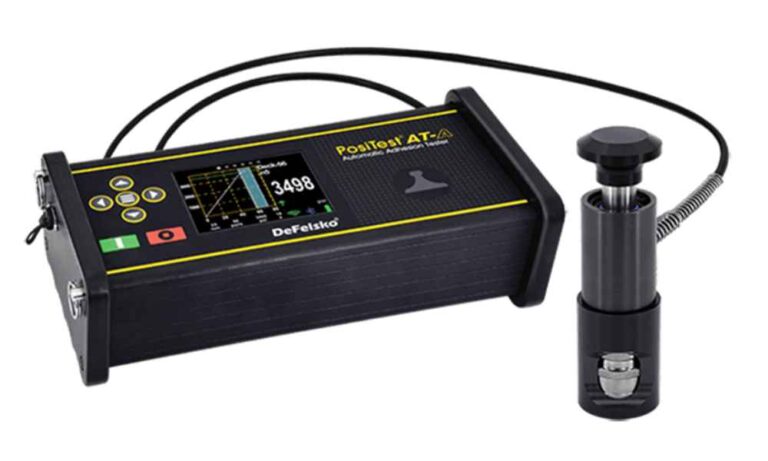
AECTL uses a DeFelsko PosiTest AT-A Automatic Adhesion Tester. The instrument uses an electronically controlled hydraulic pump to apply smooth, continuous pull-off pressure at a user-selected rate. The automatic loading sequence reduces the potential for variation associated with manual pumping and helps provide a consistent test procedure.
Useful capabilities of the PosiTest AT-A include:
The platform supports different dolly sizes and stand-off configurations. Smaller dollies extend the measurable range for higher-strength coating systems, whereas larger dollies are suited to lower-strength systems and substrates such as concrete. The selected configuration must match the expected strength, substrate and nominated standard.
Subject to the nominated standard and test configuration, pull-off adhesion testing can be applied to:
The method is intended for rigid substrates. Flexible substrates, very thin components, highly irregular surfaces or brittle materials may require additional consideration because substrate deformation, geometry or premature substrate fracture can influence the result.
The portable automatic system allows AECTL to undertake on-site coating adhesion testing in Sydney, throughout NSW and at project locations across Australia. Field testing is suitable for installed coating systems where laboratory panels would not represent the actual substrate preparation, application conditions or service environment.
Typical field applications include:
Pull-off testing is normally locally destructive. The dolly and a small area of coating are removed during testing, and repair of the test location may be required after completion.
Coated components, representative specimens and test panels can be submitted to AECTL’s Sydney laboratory for controlled testing. Laboratory work is particularly useful for coating qualification, product comparison, quality control, surface preparation trials, application or curing studies and investigation of coating delamination.
Verify whether an applied coating system satisfies a nominated pull-off requirement and document the result against the project specification or manufacturer’s acceptance criterion.
Determine whether premature peeling or delamination is associated with the coating-to-substrate interface, an intercoat boundary, the coating itself, substrate fracture or another part of the bonded system.
Compare coating performance following different surface preparation procedures or investigate whether an existing preparation method is producing adequate bond performance.
Compare candidate coating systems, trial panels or application procedures before full-scale use.
Assess the tensile bond behaviour of coatings applied to concrete using the test configuration and method appropriate to the project.
Generate quantitative adhesion data to support maintenance, repair, recoating or remediation decisions for existing assets.
A pull-off result should be interpreted in the context of the coating system and the condition being investigated. Where required, AECTL can combine adhesion testing with other materials and coating assessment techniques to identify why a system is performing satisfactorily or why deterioration has occurred.
For example, an investigation of coating delamination may consider pull-off strength and fracture location together with coating thickness, surface condition, contamination, corrosion morphology, coating cure and substrate preparation. This provides a stronger engineering basis than relying on a single adhesion value.
Depending on the agreed scope and applicable method, AECTL reporting can include:
A result is not automatically satisfactory or unsatisfactory because of the MPa value alone. Acceptance should be based on the applicable specification and must take account of the test configuration and the location of fracture.
AECTL combines automatic pull-off measurement with materials engineering, coating inspection, corrosion assessment and failure investigation capability. This allows the service to extend beyond simply recording a numerical pull-off value. Where required, the fracture mode, coating condition, substrate behaviour and project specification can be considered together to provide a technically meaningful assessment.
For an accurate quotation, please provide the coating type or coating system, substrate material, applicable standard or project specification, acceptance criterion, number and approximate location of tests, and whether testing is required on site or in the laboratory. Relevant coating drawings, specifications and product data sheets are also useful where available.