Advanced Engineering Consultancy & Testing Laboratory
Centre for Advanced Testing, Inspection and Engineering Solutions

Advanced Engineering Consultancy & Testing Laboratory
Centre for Advanced Testing, Inspection and Engineering Solutions
Learn the best signs of concrete deterioration, their likely causes, and how condition assessment supports safer, compliant asset decisions early on.
A hairline crack in a concrete wall may be cosmetic. The same crack, when it is widening, damp after rain, or accompanied by rust staining, can indicate a developing durability or structural problem. The best signs of concrete deterioration are rarely interpreted in isolation. Asset owners and engineers need to consider the pattern, location, progression, exposure conditions, and consequences of each symptom before selecting a repair strategy.
Concrete is a composite material, and deterioration can involve the cement matrix, aggregates, reinforcing steel, joints, coatings, or embedded components. A competent condition assessment distinguishes between superficial defects and mechanisms that may reduce load capacity, serviceability, safety, or design life. This distinction is particularly important for bridges, water assets, industrial floors, marine structures, retaining walls, tanks, parking facilities, and process infrastructure.
Concrete can conceal significant damage beneath an apparently intact surface. Chloride contamination, carbonation, sulfate attack, alkali-silica reaction, and reinforcement corrosion may develop for years before obvious spalling occurs. Conversely, some visible cracking is expected in restrained or drying concrete and may not indicate a critical defect.
The engineering question is not simply whether damage exists. It is whether the observed condition reflects an active deterioration mechanism, how far that mechanism has progressed, and whether it affects the asset’s required performance. That requires systematic inspection supported, where appropriate, by nondestructive testing, targeted sampling, laboratory analysis, and structural engineering review.
Cracks are among the most common signs of concrete distress, but width alone does not establish severity. Fine, stable shrinkage cracks may have limited structural significance, while diagonal cracks near supports, flexural cracks in beams or slabs, or cracks that continue to open can indicate movement, overload, settlement, restraint, or reinforcement corrosion.
Map cracking by recording its width, orientation, length, and location. Reinspection or crack monitoring can establish whether it is active. Water seepage, staining, displacement across the crack, and cracking concentrated around penetrations or joints are useful indicators that further investigation is warranted.
Spalling occurs when concrete breaks away from the surface. Delamination is a near-surface separation that may not yet be visible but can often be identified through sounding, chain drag surveys, or suitable nondestructive methods. Both conditions commonly result from reinforcement corrosion, freeze-thaw damage, inadequate cover, impact, or poor consolidation during construction.
Where reinforcing steel is exposed, section loss and bond loss should be assessed rather than assumed. Loose concrete presents an immediate personnel hazard in elevated structures, while loss of cover accelerates moisture and contaminant ingress. Repairs that replace only the detached concrete without addressing the corrosion mechanism can have a short service life.
Rust-colored staining on concrete surfaces, especially along reinforcement lines, is a strong warning sign. As steel corrodes, corrosion products can occupy substantially more volume than the original steel. This expansion creates tensile stresses in the surrounding concrete, causing longitudinal cracking, delamination, and eventual spalling.
Corrosion may be driven by chloride ingress, carbonation-induced depassivation, persistent moisture, electrical effects, or a combination of exposures. The appropriate investigation may include cover measurement, carbonation depth, chloride profile testing, corrosion potential mapping, resistivity testing, and localized steel inspection. Each method provides part of the condition picture; no single result should be treated as a complete corrosion diagnosis.
White crystalline deposits, commonly called efflorescence, occur when moisture transports soluble salts to the concrete surface. They do not automatically mean the concrete has lost structural integrity, but they confirm a moisture pathway that deserves attention. In water-retaining, below-grade, or marine assets, recurring dampness can be more consequential than the white deposits themselves.
Leaching can also leave pale streaks or deposits beneath cracks and joints. Over time, continued water movement may alter the concrete matrix, contribute to joint failure, or transport contaminants to reinforcement. The source of water – such as failed waterproofing, drainage deficiencies, leaking joints, or process exposure – should be identified as part of the repair scope.
Surface scaling is the loss of mortar or shallow concrete from a slab, pavement, or exposed face. It may result from freeze-thaw exposure, deicing chemicals, poor finishing practices, insufficient curing, or low near-surface strength. Abrasion, by contrast, is often associated with traffic, bulk materials handling, or hydraulic action.
The condition of the surface must be evaluated against its service environment. A worn warehouse floor may primarily require a wear-resistant repair system, while scaling in a bridge deck can increase permeability and accelerate reinforcement corrosion. Core samples, surface hardness assessment, petrographic examination, and compressive strength testing may be needed when the extent or cause is uncertain.
Small conical holes, pop-outs, or localized aggregate fractures can indicate reactive, porous, or otherwise susceptible aggregate particles. Widespread map cracking, gel-like exudation, or crack patterns around aggregate may point to alkali-silica reaction. This mechanism can cause progressive expansion and is not resolved by a cosmetic surface treatment.
Petrographic examination and microscopy are particularly valuable when aggregate-related distress is suspected. They can help differentiate alkali-silica reaction from freeze-thaw damage, delayed ettringite formation, sulfate attack, poor-quality materials, or construction defects. The remedy depends on the mechanism, so accurate diagnosis is essential before committing to a major rehabilitation program.
Failed sealants, damaged joint arrises, stepped cracking, or vertical displacement between adjacent slab panels can indicate movement beyond the joint’s intended capacity. Causes may include settlement, thermal cycling, inadequate dowels, subbase deterioration, restrained shrinkage, or repeated heavy loading.
Movement-related defects need a broader review than the concrete face alone. Drainage, foundations, soil support, adjacent structures, loading history, and joint detailing may all be relevant. Patching a displaced joint without resolving the underlying movement can lead to repeated failure and operational disruption.
A hollow sound during hammer sounding or chain drag testing can identify areas of delamination beneath a seemingly sound surface. This is especially useful on decks, slabs, facades, and thick protective concrete covers. However, sounding is a screening technique, not a measure of remaining capacity or corrosion rate.
Suspect areas should be documented and correlated with other evidence such as cracking, moisture, cover depth, and reinforcement location. Where access, geometry, or asset criticality warrants it, ground-penetrating radar, ultrasonic methods, impact echo, or other appropriate techniques can improve definition of subsurface conditions.
A reliable assessment begins with a clear purpose. A pre-purchase inspection, a repair design, a safety review, and a remaining-life assessment each require different levels of investigation. Defining the asset’s function, exposure environment, loading, repair history, and failure consequences helps target the work efficiently.
A typical program combines a visual inspection with defect mapping, photographs, dimensional measurements, and review of available drawings and maintenance records. Testing can then be selected to answer specific questions: Is reinforcement corroding? Have chlorides reached the steel depth? Is carbonation significant? Is the concrete weak, permeable, chemically altered, or affected by an expansive reaction?
Representative sampling matters. A single core or powder sample may confirm a local condition but cannot automatically characterize an entire structure. Sampling locations should be justified by observed distress, exposure zones, reinforcement configuration, and the decisions the results will support. Accredited laboratory testing and appropriately documented inspection procedures provide confidence that results are traceable and defensible for owners, regulators, insurers, and repair contractors.
Prompt engineering review is appropriate when defects affect load-bearing members, public-access areas, elevated concrete, water-retaining structures, critical process assets, or zones exposed to chlorides and aggressive chemicals. Escalation is also prudent where cracking is active, spalling is widespread, reinforcement is exposed, or deterioration is progressing despite previous repairs.
The practical objective is not to test every square foot of concrete. It is to obtain enough reliable evidence to manage risk, prioritize intervention, and specify repairs that address both the visible damage and its cause. For complex or high-consequence assets, AECTL can combine condition assessment, materials testing, corrosion evaluation, and engineering consultancy to support a tailored, technically defensible scope.
Early investigation gives owners more repair options. When concrete deterioration is identified before extensive steel loss, delamination, or operational interruption occurs, maintenance can be planned around the asset rather than dictated by an avoidable failure.
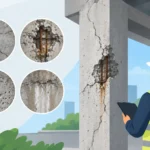


[…] the actual condition of the structure rather than relying solely on drawings or visual assumptions. Concrete condition assessment can identify cracking, delamination, carbonation, chloride contamination, strength variability, and […]