Advanced Engineering Consultancy & Testing Laboratory
Centre for Advanced Testing, Inspection and Engineering Solutions
Advanced Engineering Consultancy & Testing Laboratory
Centre for Advanced Testing, Inspection and Engineering Solutions
Sustainable infrastructure depends on verified materials, durable design, and condition data that support safe, compliant, cost-effective assets over time
A bridge deck specified for a 100-year design life can still require major intervention far earlier if chloride exposure, cracking, drainage, construction quality, or material variability were not properly addressed. That gap between design intent and field performance is where sustainable infrastructure succeeds or fails. Sustainability is not only a carbon calculation at project approval. It is the ability of an asset to remain safe, functional, maintainable, and economically defensible throughout its service life.
For asset owners, designers, contractors, and government agencies, this requires decisions supported by evidence. Material selection, weld quality, corrosion protection, concrete durability, inspection planning, and condition data all influence whether an asset delivers its intended life or transfers risk and cost to future budgets.
Sustainable infrastructure is often discussed through renewable energy, recycled content, low-carbon concrete, electrified transport, or water efficiency. These measures matter, but they are incomplete if they are considered separately from reliability and asset integrity. A lower-impact material that cannot achieve the required durability in its operating environment may increase whole-of-life environmental and financial costs through premature repairs, replacement, traffic disruption, and resource consumption.
The engineering question is therefore not simply, “What has the lowest initial footprint?” It is, “What solution delivers the required performance with the lowest credible lifecycle impact?” The answer depends on exposure conditions, loading, inspection access, maintenance capability, availability of replacement components, and the consequences of failure.
For example, a coastal structure may require a more demanding concrete mix design, reinforcement strategy, coating system, or cathodic protection approach than an equivalent inland asset. The initial cost may be higher. However, where chloride ingress and corrosion are credible threats, the alternative can be repeated remediation and an earlier loss of serviceability. Sustainability and durability are aligned when design choices are based on the actual deterioration mechanisms an asset will face.
A design model is only as dependable as the data behind it. Sustainable outcomes begin with representative information about materials, ground conditions, chemistry, loads, exposure, and construction constraints. Assumptions that remain untested can become expensive defects embedded in the asset.
Material characterization is particularly important when specifying new products, alternative binders, recycled aggregate, high-strength steels, protective coatings, or repaired components. Chemical analysis, mechanical testing, metallography, and microstructural examination can establish whether a material meets specification and whether its behavior is suitable for the intended application. When novel materials or nonstandard combinations are proposed, custom test method development may be necessary to evaluate the performance that standard tests do not fully capture.
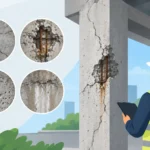
The same principle applies to existing assets. Before extending service life, changing duty, or designing a repair, decision-makers need to know the actual condition of the structure rather than relying solely on drawings or visual assumptions. Concrete condition assessment can identify cracking, delamination, carbonation, chloride contamination, strength variability, and other durability indicators. For metallic assets, corrosion assessment, thickness measurement, positive material identification, and coating inspection can clarify the remaining margin before intervention is required.
This evidence protects against two costly errors: replacing an asset or component that could safely remain in service, and retaining one whose deterioration is more advanced than surface observations suggest.
Certificates of conformity are valuable, but they do not eliminate the need for project-specific verification. Supply-chain substitutions, traceability gaps, storage conditions, fabrication practices, and installation quality can materially affect performance. A compliant product can still be unsuitable if it is incorrectly selected, improperly applied, or incompatible with adjacent materials.
Welding provides a clear example. Weld procedure qualification, welder qualification, inspection, and targeted nondestructive or destructive testing help confirm that joints will perform under the expected loads and environment. In critical steelwork, a material mix-up can compromise corrosion resistance, toughness, or strength. Positive material identification provides a practical control where alloy verification is necessary.
Coating systems present similar risks. Their long-term effectiveness depends on surface preparation, environmental conditions during application, dry-film thickness, adhesion, cure, and the treatment of edges, welds, and damaged areas. Coating inspection is not an administrative checkpoint. It is a durability control with direct implications for corrosion rates, maintenance intervals, and lifecycle cost.
Many infrastructure durability problems originate not in the concept design but in execution. Poor compaction, inadequate curing, incorrect cover, uncontrolled welding heat input, contaminated surfaces, or incomplete records can shorten service life long before deterioration becomes visible.
Quality assurance should therefore focus on the failure modes that matter most for the asset. For a concrete water-retaining structure, that may include mix consistency, curing performance, cracking controls, permeability-related indicators, and construction joint detailing. For a fabricated steel structure, it may center on material traceability, weld quality, dimensional accuracy, protective treatment, and inspection hold points.
An effective inspection and test plan identifies what must be checked, when it must be checked, which acceptance criteria apply, and how results will be recorded. It should also define escalation paths for nonconformance. The purpose is not to generate paperwork. It is to prevent a minor deviation from becoming a long-term integrity issue that is difficult to access and expensive to repair after commissioning.
Independent, accredited testing and ISO 17020 inspection services provide added assurance where compliance, contractual obligations, public safety, or high consequence of failure are involved. They create defensible records and give project teams an objective basis for accepting work, requesting rectification, or evaluating technical alternatives.
Maintenance is sometimes treated as a recurring cost to be minimized. For critical infrastructure, the more useful objective is to apply the right intervention at the right time. Deferred maintenance can allow a manageable defect to develop into a structural, operational, or safety event. Conversely, blanket replacement programs can consume capital and materials where condition-based planning would have identified lower-impact options.
A condition assessment should move beyond a general rating whenever decisions involve substantial cost or risk. Visual observations are a starting point, but they may need to be supported by sampling, laboratory testing, corrosion evaluation, materials analysis, or failure investigation. The appropriate scope depends on the asset type, deterioration mechanism, access constraints, and decision being made.
Trend data is especially valuable. Repeated measurements of section loss, crack behavior, coating condition, chemical exposure, or concrete durability indicators can distinguish a stable issue from an active one. This supports remaining-life assessments and enables owners to prioritize repairs based on consequence and rate of deterioration rather than age alone.
For assets with unusual failures or conflicting evidence, advanced analysis can resolve uncertainty. SEM/EDS can examine fracture surfaces, deposits, or corrosion products. XRD and FTIR can help identify crystalline phases, contaminants, degradation products, or coatings. Reverse engineering and failure analysis can establish why a component failed and whether the cause is isolated or systemic. These methods are most valuable when their results are translated into a practical corrective action, not treated as an academic exercise.
There is no universal material, design detail, or maintenance strategy that is sustainable in every application. Higher-strength materials can reduce section sizes but may introduce fabrication, inspection, or fracture-toughness considerations. Recycled content can reduce demand for virgin resources but may require tighter control of variability. Protective coatings can extend steel life but require careful surface preparation and future renewal planning. Design redundancy can improve resilience while increasing initial material use.
These are not reasons to avoid innovation. They are reasons to assess innovations against the operating context and verify their performance. A credible decision process considers embodied impacts, service life, constructability, inspection requirements, repairability, supply-chain reliability, safety, and whole-life cost together.
It also recognizes that resilience has a sustainability value. Infrastructure exposed to flooding, heat, salt, abrasion, vibration, or industrial chemicals must be designed for credible future conditions, not only historic averages. An asset that cannot tolerate foreseeable environmental change may require early adaptation or replacement, even if its initial footprint appeared favorable.
The strongest sustainability programs integrate technical assurance from concept through operation. At concept stage, teams identify exposure conditions, critical failure modes, and realistic design-life objectives. During detailed design, they verify the suitability of materials and protective systems. During construction, they use defined inspection and testing controls to confirm that specified performance is achieved. During operation, they collect condition data that supports targeted maintenance and informed renewal decisions.
This approach also improves communication between designers, contractors, owners, and regulators. Clear test results, inspection records, and technical assessments turn subjective debates into decisions that can be defended against specifications, standards, and the actual condition of the asset.
AECTL supports this process through NATA-accredited testing, ISO 17020 inspection, asset condition assessment, materials analysis, corrosion evaluation, welding and coating inspection, and engineering consultancy. The objective is not simply to identify defects. It is to provide reliable technical evidence that helps clients select proportionate, cost-effective actions.
The most durable infrastructure decisions are rarely the ones that look cheapest at procurement. They are the decisions that account for how materials, workmanship, environment, and maintenance will interact over decades – then verify those assumptions before the cost of being wrong is built into the asset.