Advanced Engineering Consultancy & Testing Laboratory
Centre for Advanced Testing, Inspection and Engineering Solutions
Advanced Engineering Consultancy & Testing Laboratory
Centre for Advanced Testing, Inspection and Engineering Solutions
Learn the best ways to prevent corrosion with material selection, coating control, inspection, and environment-specific asset integrity planning today.
A coating failure at a flange, a crevice beneath insulation, or a small change in process-water chemistry can begin degrading an asset long before visible rust appears. The best ways to prevent corrosion are therefore not limited to applying paint or specifying a higher-grade alloy. They require a defensible understanding of the material, environment, design details, operating conditions, and inspection evidence that govern corrosion risk over the asset life.
For industrial, infrastructure, marine, energy, and water assets, the consequence of corrosion can extend well beyond replacement cost. It can affect containment, structural capacity, availability, public safety, environmental obligations, and compliance. Effective prevention is a lifecycle discipline that starts before procurement and continues through operation, maintenance, repair, and eventual decommissioning.
Corrosion control becomes inefficient when the mechanism has not been identified. General atmospheric corrosion, galvanic corrosion, pitting, crevice corrosion, microbiologically influenced corrosion, erosion-corrosion, and stress corrosion cracking do not respond to the same controls. A coating system that performs well in a dry industrial atmosphere may fail rapidly under immersion, cyclic wetting, chloride deposition, or elevated temperature.
The first technical question should be: what is the metal exposed to, and how does that exposure change over time? Consider chlorides, pH, dissolved oxygen, moisture retention, temperature, electrical continuity, flow velocity, deposits, microbes, and chemical cleaning regimes. For buried or submerged infrastructure, soil resistivity, groundwater conditions, stray current, and cathodic protection interactions may be equally significant.
Failure analysis, corrosion testing, chemical analysis, and metallurgical examination can establish whether observed damage is consistent with the assumed mechanism. This evidence is particularly valuable when an asset is deteriorating faster than its design basis predicted. Treating the symptom without confirming the mechanism can result in repeated repairs and unnecessary downtime.
Material selection is one of the most effective corrosion controls, but “corrosion-resistant” is not a universal material category. Stainless steel, aluminum, carbon steel, galvanized steel, duplex stainless steel, nickel alloys, and nonmetallic materials each have service limits. The appropriate choice depends on the full exposure profile, not simply the nominal fluid or ambient environment.
For example, a stainless steel grade may resist uniform corrosion but remain susceptible to chloride-induced pitting or crevice corrosion where deposits accumulate. Carbon steel can offer a cost-effective solution when a properly specified coating, corrosion allowance, or cathodic protection system is practical. Higher-alloy materials can reduce maintenance demand in aggressive conditions, but only if fabrication, welding, heat treatment, and contamination control are also managed correctly.
Specifications should account for material chemistry, mechanical properties, welding consumables, heat input, surface finish, joint configuration, and fabrication traceability. Positive material identification is useful where material mix-ups could create localized weak points in piping, pressure equipment, structural steel, or fabricated assemblies. Verification is often far less costly than discovering an incorrect alloy after commissioning.
Many corrosion problems originate in geometry rather than in a material defect. Poor drainage, horizontal ledges, lap joints, unsealed gaps, inaccessible surfaces, and interfaces between dissimilar metals can retain electrolytes and create localized attack. These locations also tend to be difficult to clean, coat, inspect, and repair.
Design details should promote drainage and ventilation, allow access for surface preparation and inspection, and avoid narrow crevices where practical. Where contact between dissimilar metals cannot be avoided, the galvanic relationship, relative surface areas, and exposure to an electrolyte should be assessed. Electrical isolation may be appropriate, although isolating components can create other inspection and electrical continuity considerations in cathodically protected systems.
Weld profiles deserve close attention. Undercut, spatter, weld overlap, sharp edges, and incomplete coating coverage can compromise both corrosion performance and coating adhesion. Welding procedure qualification and inspection help control fabrication variables that may later affect corrosion resistance, particularly in stainless steels and other alloy systems sensitive to heat-affected-zone conditions.
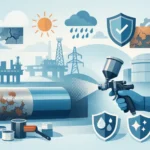
A coating is only as reliable as its compatibility with the substrate, environment, and application process. Coating selection should define the intended exposure, required surface preparation, profile, dry film thickness, curing conditions, edge treatment, stripe coating requirements, and inspection hold points. Generic product selection without these controls can produce an apparently compliant finish with a short service life.
Surface preparation remains a decisive factor. Rust, salts, oil, moisture, weld residues, and inadequate surface profile can lead to early disbondment, blistering, underfilm corrosion, or poor adhesion. In severe service, soluble salt testing and environmental monitoring during application can be as important as measuring dry film thickness after the work is complete.
Coating inspection should verify preparation standards, ambient conditions, wet and dry film thickness, discontinuities, adhesion where required, and final visual condition. Holiday detection is particularly relevant for linings and protective systems intended to isolate steel from conductive liquids or soils. The correct test method and voltage must be matched to coating type and thickness to avoid false confidence or damage to the coating itself.
Cathodic protection can be highly effective for buried, immersed, or internally exposed steel structures, including pipelines, tanks, marine structures, and reinforced concrete in selected applications. It works by shifting the electrochemical conditions so that corrosion of the protected metal is reduced. It does not eliminate the need for sound design, coating quality, and monitoring.
The choice between sacrificial anode and impressed-current systems depends on asset geometry, current demand, coating condition, design life, access, power availability, and interference risk. An inadequate design may leave areas underprotected, while excessive protection can introduce coating disbondment or hydrogen-related concerns in susceptible materials.
Routine surveys, potential measurements, continuity testing, anode assessment, and rectifier monitoring are necessary to confirm that the system continues to perform as intended. Cathodic protection should be treated as a managed asset system, not a fit-and-forget installation.
Changing the environment can be more economical than repeatedly repairing corrosion damage. In closed systems, this may involve managing pH, oxygen ingress, conductivity, inhibitor concentration, microbiological activity, and deposit formation. In process equipment, it can involve reducing stagnant periods, controlling flow regimes, limiting abrasive solids, or revising cleaning chemistry.
Corrosion inhibitors can be effective, but their performance depends on dose control, process compatibility, temperature, fluid composition, and the mechanism being addressed. An inhibitor program should be verified through monitoring and testing rather than assumed effective because it has been specified. The same applies to water-treatment programs for cooling systems, boilers, and fire-water networks.
For atmospheric structures, moisture time-of-wetness and chloride deposition can determine whether a standard maintenance cycle is sufficient. Sheltering, drainage improvements, washdown practices, dehumidification, and enclosure design may materially reduce corrosion rates in areas where coating renewal alone has not solved the problem.
Inspection planning should focus on credible damage locations and rates, not just convenient access points. Corrosion under insulation, splash zones, crevices, tank bottoms, pipe supports, dead legs, weld toes, and coating defects frequently require targeted methods and inspection intervals. Visual examination remains valuable, but it is rarely sufficient for assets with concealed or internal degradation mechanisms.
Ultrasonic thickness measurement, radiographic methods, eddy current testing, coating surveys, concrete condition assessment, and laboratory examination each provide different evidence. The selected technique should match the expected damage morphology. A broad area of uniform wall loss calls for a different approach than localized pitting, internal deposits, or corrosion associated with a failed lining.
Inspection data should feed an asset integrity plan that defines condition, remaining life assumptions, repair priorities, and future monitoring. Trend data is often more useful than a single reading because it distinguishes stable conditions from an active deterioration process. Where uncertainty is high, a targeted investigation can reduce both technical risk and unnecessary scope.
Corrosion repairs often fail early because the cause of the original damage was not addressed or because execution controls were reduced under schedule pressure. Repair specifications should define surface preparation, material compatibility, weld requirements, coating restoration, curing, inspection acceptance criteria, and documentation. The repaired area must perform as part of the whole system, not simply look complete at handover.
When degradation is unexpected, retain samples, photographs, operating records, coating fragments, deposits, and failed components before cleanup or replacement removes the evidence. Advanced materials analysis may identify corrosive species, inappropriate material selection, metallurgical anomalies, or coating failures that cannot be established through visual inspection alone.
AECTL supports corrosion assessment, accredited materials testing, coating inspection, failure investigation, and engineering consultancy where asset owners need clear, defensible evidence for repair and prevention decisions. The strongest corrosion strategy is one that is tailored to the asset’s actual exposure and verified through inspection, testing, and disciplined quality control.
Corrosion prevention becomes most valuable when it is built into project decisions before damage is visible. If an asset has recurring coating failure, unexplained wall loss, or a changing operating environment, treat that signal as a reason to investigate the mechanism now, while the range of practical corrective actions is still broad.