Advanced Engineering Consultancy & Testing Laboratory
Centre for Advanced Testing, Inspection and Engineering Solutions

Advanced Engineering Consultancy & Testing Laboratory
Centre for Advanced Testing, Inspection and Engineering Solutions
Carbon consulting helps industrial teams measure emissions, set practical reduction plans, and connect decarbonization with asset integrity and compliance.
A carbon target can look credible in a board report and still fail at the plant, project, or asset level. The reason is usually not a lack of ambition. It is a lack of reliable data, clear engineering assumptions, and practical understanding of how emissions decisions affect safety, durability, production, and cost. Carbon consulting addresses that gap by connecting emissions management to the technical realities of industrial operations.
For asset owners, manufacturers, fabricators, contractors, and infrastructure managers, the priority is not simply to calculate a footprint. It is to make decisions that can be defended to clients, regulators, investors, and internal governance teams. That requires traceable information, fit-for-purpose boundaries, and recommendations that account for asset condition and operational constraints.
Carbon consulting is the technical and strategic support used to measure, interpret, reduce, and report greenhouse gas emissions. In industrial settings, it commonly includes emissions inventories, baseline development, data quality reviews, product and project carbon assessments, decarbonization roadmaps, and support for disclosure or procurement requirements.
The value of the work depends on the quality of the evidence beneath it. Fuel purchase records, electricity data, production volumes, material certificates, transport distances, waste records, maintenance histories, and supplier information may all be relevant. A consultant must determine which records are applicable, how complete they are, and what assumptions are necessary where direct evidence is unavailable.
This is particularly important where a business operates energy-intensive equipment, maintains aging infrastructure, uses carbon-intensive materials, or delivers projects with long service lives. A narrow calculation may identify a lower-emission option on paper while overlooking early replacement, increased maintenance, corrosion exposure, or a higher risk of operational failure.
The first question should be: what decision must this assessment support? The answer determines the boundary, level of detail, and evidence required.
A corporate inventory may be appropriate when leadership needs an organization-wide baseline and reduction target. A construction project may require embodied-carbon comparisons for concrete, steel, coatings, transport, and installation activities. A manufacturer may need to understand emissions per unit of production, while an asset owner may be assessing whether repair, rehabilitation, or replacement provides the better whole-of-life outcome.
Using the same approach for every purpose creates avoidable cost and confusion. An overly broad assessment can consume time without improving the decision. An overly simple assessment can create reporting risk or lead to a recommendation that cannot be implemented.
A sound scope defines the reporting period, organizational or project boundary, emission categories, relevant standards or client requirements, data sources, calculation methodology, and intended users of the final output. It also identifies exclusions early. Exclusions are not inherently a problem, but they must be transparent and technically justified.
A baseline is more than a total number. It is the reference point against which future performance will be measured, so it must be sufficiently consistent to support comparison over time.
For direct emissions, teams commonly examine stationary fuel combustion, mobile plant and fleet fuel, onsite generators, process emissions, and refrigerants. Indirect energy emissions typically cover purchased electricity, steam, heating, or cooling where applicable. Value-chain emissions can extend to purchased materials, freight, subcontracted activities, waste, employee travel, use of sold products, and end-of-life treatment.
The difficult work is often in the data. Utility records may be consolidated across multiple sites. Fuel records may not distinguish between equipment types. Material quantities may be available from procurement systems but lack supplier-specific carbon information. A rigorous carbon consulting engagement documents these limitations, applies appropriate emission factors, and assigns confidence levels to the result.
That discipline protects the organization from false precision. Reporting an emissions figure to several decimal places does not make it reliable if the underlying activity data is estimated or incomplete. Decision-makers need to understand both the result and the confidence they can place in it.
Decarbonization decisions should be evaluated alongside engineering performance. This is especially relevant for infrastructure, energy, marine, mining, water, transport, and manufacturing assets, where material selection and maintenance strategy can influence emissions for decades.
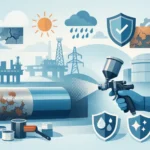
Consider a protective coating system. A lower-impact product may reduce embodied emissions at installation, but its suitability depends on the exposure environment, surface preparation requirements, application controls, expected service life, inspection regime, and compatibility with the existing system. If premature coating failure leads to repeated maintenance or corrosion-related repairs, the whole-of-life emissions and cost may exceed those of a more durable alternative.
The same principle applies to repair versus replacement decisions. Retaining an asset can avoid the emissions associated with new material production and construction. However, retention is not automatically the lower-carbon choice if the component has significant section loss, recurring failure mechanisms, or ongoing energy inefficiency. Condition assessment, corrosion analysis, non-destructive inspection, materials testing, and failure investigation provide the evidence needed to make this trade-off responsibly.
For capital projects, early design choices carry significant influence. Optimizing structural layouts, specifying appropriate material grades, reducing rework, designing for inspection access, and selecting durable materials can reduce both construction emissions and future intervention requirements. These measures must remain compliant with design codes, safety obligations, and performance specifications.
The most useful reduction roadmap is not a catalog of aspirations. It is a staged plan that identifies actions, expected emissions impact, implementation requirements, capital implications, operational risks, dependencies, and measurement methods.
Energy efficiency opportunities may provide relatively fast results where equipment condition, operating profiles, and energy data are well understood. Electrification can be effective, but outcomes depend on equipment duty cycles, available power capacity, grid emissions intensity, uptime requirements, and the feasibility of backup arrangements. Material substitution can reduce embodied carbon, but only where mechanical properties, weldability, corrosion resistance, availability, and certification requirements have been evaluated.
A practical roadmap should distinguish between no-regrets actions and measures that require further investigation. Improving data capture, reducing avoidable energy waste, minimizing material scrap, and preventing rework are often sensible starting points. Larger interventions, such as process redesign, fuel switching, renewable generation, or major asset replacement, require deeper engineering and commercial assessment.
The timing matters as much as the target. A company may have a credible long-term objective but still need a near-term plan for procurement requirements, client reporting, or regulatory obligations. Intermediate milestones make progress measurable and reveal whether actual reductions are tracking with planned reductions.
Carbon claims are increasingly examined by clients, regulators, financiers, and supply-chain partners. A calculation that cannot be traced to source data, a defined method, and documented assumptions is difficult to defend.
Technical assurance should focus on the reliability of activity data, appropriate use of emission factors, consistency of boundaries, treatment of estimates, and change control when operations or methodologies evolve. This does not always require the same level of review. The appropriate assurance approach depends on the intended claim and the consequences of error.
For example, an internal screening assessment may reasonably use secondary data and broader assumptions. A submission supporting a contractual commitment, public disclosure, environmental product claim, or major investment decision generally demands stronger records and more formal review. The required level of rigor should be set before analysis begins, not after a result has been produced.
Accredited testing and inspection capabilities can strengthen the technical basis for carbon decisions where material performance, asset condition, or process reliability is central to the outcome. Laboratory analysis, corrosion assessment, coating inspection, weld evaluation, and engineering investigation help ensure that emissions reduction measures do not introduce unacceptable safety, quality, or durability risks.
External expertise is valuable, but the strongest programs also build internal capability. Operations, maintenance, procurement, quality, finance, and engineering teams each hold part of the required information. Clear ownership of data and defined review processes prevent the carbon program from becoming an isolated annual reporting exercise.
AECTL supports industrial clients with technically grounded engineering advice where emissions objectives intersect with materials performance, durability, failure risk, and asset life. The objective is not to prescribe a generic pathway, but to provide clear evidence that supports compliant, cost-aware decisions.
The best next step is often a focused diagnostic: identify the decision ahead, test the quality of the available evidence, and determine where emissions, engineering risk, and asset strategy are most closely linked. That is where carbon work becomes operationally useful rather than simply reportable.